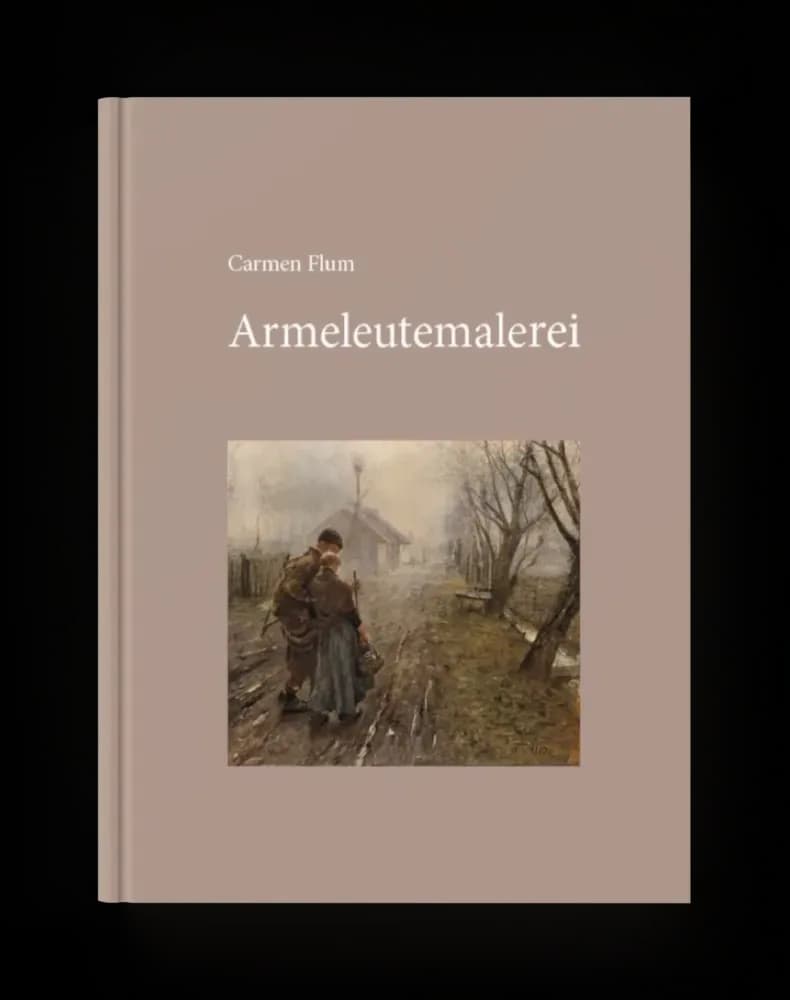
Many art critics described the depictions of poverty and misery that could be seen at exhibitions all over Europe at the end of the 19th century as “poor people’s painting.” This volume is the first to examine poverty in German art from 1830 to 1914 from various perspectives. On the basis of contemporary sources (exhibition and collection catalogs, monographs, art magazines and other illustrated magazines), around 680 pictures, drawings and graphics of poor people were collected and evaluated. This made it possible to determine how high the proportion of depictions of poverty was at the academy exhibitions in Berlin and Munich or which paintings were shown in the illustrated magazines. Another section is dedicated to the way poverty is dealt with in the satirical magazines Flying Leaves and Simplicissimus.
Poverty had many faces in the 19th century and offered artists a wealth of options when implementing it. An extensive chapter therefore deals with the themes of poor people's painting and shows how they have changed and developed over the years. With Ferdinand Georg Waldmüller, Carl Wilhelm Hübner, Ludwig Knaus, Max Liebermann, Fritz von Uhde, Heinrich Zille, Käthe Kollwitz and Hans Baluschek, eight painters are also presented who have dealt intensively with hardship, misery and social injustice in their works.
Poor man painting was controversially discussed in the exhibition discussions. Poverty in the visual arts was obviously a subject that could inflame emotions, all the way up to the emperor. The critics denounced many images that showed hunger and misery as “socialist tendencies” or dismissed them as “Parisian imports.” Only rarely were the discussions actually about the paintings.
Finally, the question arises as to what the Poor People's Painting intended - and what it actually achieved. The audience almost always assumed that a painter had something in mind by depicting poor women, men and children. The viewer's social attitude played a role in the effect of the paintings and graphics. And so the last part of the book is dedicated to the visions of the poor people's painters and the actual influence of their works on politics and society.
The volume contains 115 illustrations (60 of them in color), three tabular lists, a list of the works on which the study is based, as well as an extensive bibliography and index of people.
Reviews:
Maximiliane Buchner, review of: Carmen Flum: Poor People Painting. Depictions of poverty in German-speaking countries 1830-1914, Merzhausen: ad picturam 2013, in: see points 15 (2015), No. 11, November 15, 2015: http://www.sehe points.de/2015/11/24617.html.
Elke Brüns, Get out of the gutter. Pity or voyeurism? Carmen Flum examines the genre of “poor people painting”, in: Der Tagesspiegel (Berlin), April 22, 2014,
URL: http://www.tagesspiegel.de/kultur/armut-in-der-kunst-raus-aus-dem-rinnstein/9790840.html