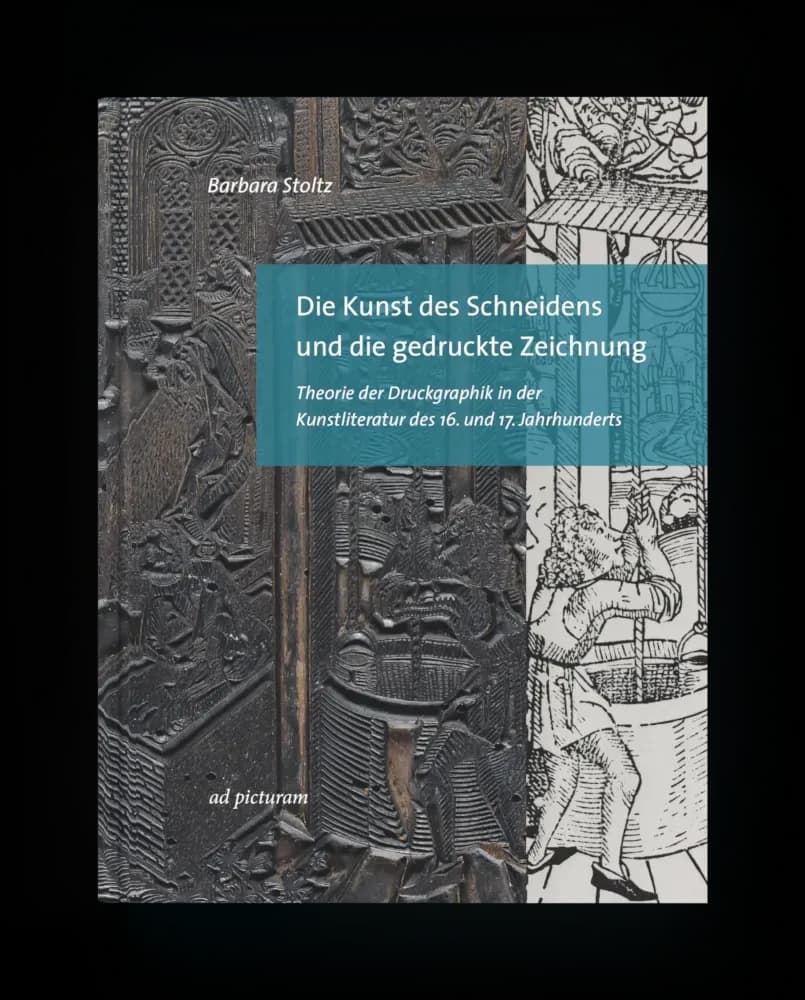
Since the early art-literary treatment of printmaking, the fundamental question has been raised as to what printmaking ultimately is. This is anything but a simple problem for the literature of the pre-academic or early academic period, in view of an art genre that consists of three supporting elements: the printing plate, the printing process and the printed image. The treatises of the 16th and 17th centuries therefore offer a variety of diverging statements and interpretations of the art of printmaking, which, on the one hand, can be summed up as an oscillating view between the art of cutting or engraving on the printing plate and its appearance on the printed page, and, on the other hand, must submit to the dominance of the competing main genres of painting and sculpture.
In an analysis of the prominent art literature of the early modern period, such as Vasari's Vite (1550/68), Van Mander's Schilder-Boeck (1604) or André Félibien's Entretiens (1666–88), the book presents a selection of these discussions and discussions of printmaking art and focuses in particular on its fundamental elements of the printing plate, printing process and printed image. The questions about belonging to other genres or the independence of printmaking are the central aspects that are deepened in the discussion of the specific printmaking imagery by Lucas van Leyden, Domenico Beccafumi and Rembrandt van Rijn.
However, the definitions and attempts at definition are not the sole subject of the art theoretical understanding of printmaking in the early modern period. The results of the investigations presented in this book include, above all, the insight that the theory of printmaking is closely intertwined with the fundamental questions of fine art, in particular with the concepts of inventio and imitatio, which in turn provide an insight into the prevailing approach in art literature to the function of reproduction and into the actual handling of author's own and reproducing print images. The book thus offers a comprehensive overview of the factual understanding of printmaking in literature on early modern art.
The book presents the results of the DFG project Art Theory of Graphics, which was realized at the Philipps University of Marburg and at the Art History Institute in Florence.
About the author:
Barbara Stoltz studied art history and Italian philology at the Philipps University of Marburg and at the
Ca' Foscari in Venice. She did her doctorate on art theory and literary criticism of the 16th century (Law of Art - Ordo of the World. Federico Zuccaro's Dante Drawings, published in 2011). Her research focuses include pre-modern and contemporary art theory as well as printmaking and metal art.
This publication is published with the kind support of the Fonte Foundation and the German Research Foundation