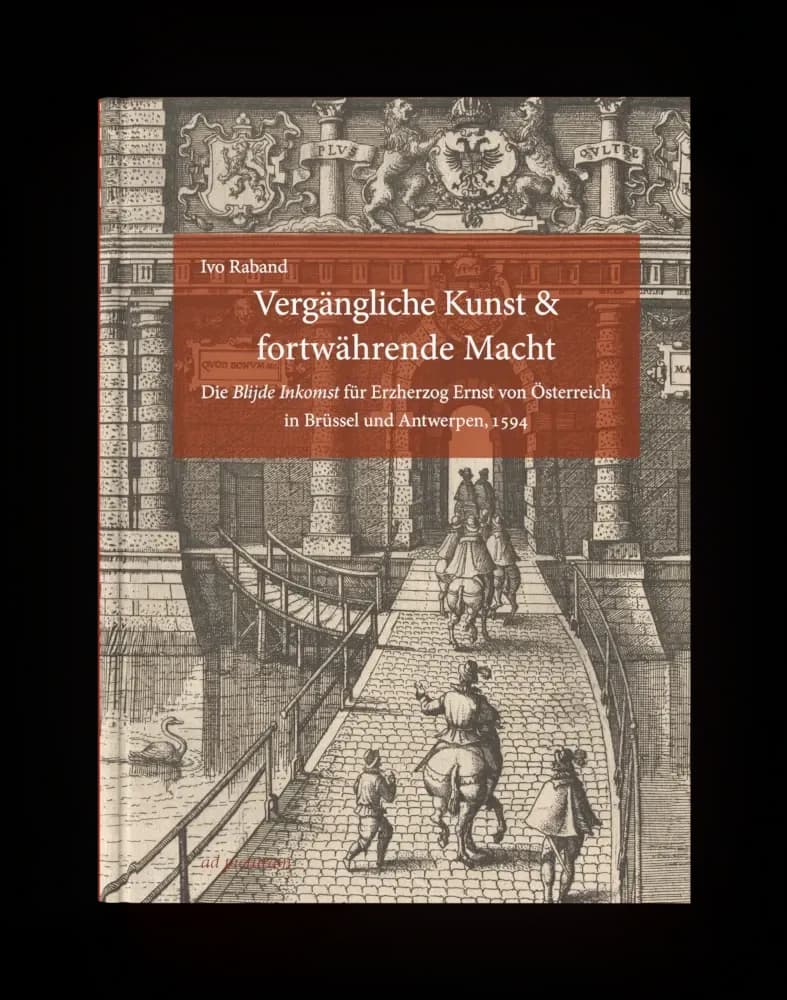
The Habsburg Ernst of Austria (1553–1595), second son of Emperor Maximilian II, was appointed governor of the Spanish Netherlands in 1593. The Archduke reached his new residence, Brussels, on January 30, 1594, where he was greeted with the triumphant entry of the Blijde Inkomst - the traditional "happy entry"; The second entry into the illustrious trading metropolis of Antwerp followed in June. The death of the Archduke after only 13 months in the Netherlands and his political insignificance have meant that this event, which offers an insight into the Spanish Netherlands at the height of the Eighty Years' War, has so far been receded in research.
The study examines the ephemeral festival apparatus, stages, tableaux vivants and performances designed by the cities in honor of the Archduke based on their subsequently published festival books. Both are probably the most elaborate and impressive examples of their kind
16th century can be counted. The series of engravings recorded in these books consist of 26 (Brussels) and 35 (Antwerp) sheets. All 61 prints are being subjected to detailed art historical analysis and classification for the first time.
The question then arises as to what impact the visually powerful and impressive Blijde Inkomst had on the development of power and splendor as well as on the dynastic and confessional self-image of the Habsburgs in the Netherlands. For this purpose, the first step is to examine a printed portrait of the Archduke commissioned from the brothers Otto and Gijsbert van Veen, which directly related to the themes and motifs of the entry. This is followed by the analysis of Ernst of Austria's collection in his apartment in the Brussels Palace, which expands the study to include a survey of the governor's regional and dynastic collecting habits. The archduke's inventory of his estate and his cash book are fundamental here; two sources, both preserved in the Royal Archives in Brussels. Finally, the question is examined as to what the intentions of Ernst's brother and successor - Archduke Albert of Austria (1559–1621) - were in erecting a highly innovative and representative grave monument in the high choir of St. Gudula's Church in Brussels.
As part of the study, different places and media of performative and visual arts were identified and current methods from the fields of art history, historiography, social history and religious history were used. Using the example of the Blijde Inkomst for Ernst of Austria, an updated look is taken at the art and social history of the Spanish Netherlands in the 1590s - a time that was characterized by religious and dynastic conflicts and economic changes in an ever faster globalizing world.
About the author:
Ivo Raband studied art history and German at the University of Osnabrück and art and visual history at the Humboldt University in Berlin. In 2016 he received his doctorate at the University of Bern with the above-mentioned dissertation. From May 2016 to January 2018 he was a research assistant at the Chair of Modern Art History at the University of Bern. In spring 2018, Ivo Raband was a junior fellow at the interdisciplinary Walter Benjamin Kolleg in the Faculty of Philosophy and History at the University of Bern. From September 2018 to May 2019, an Early Postdoc.Mobility grant from the Swiss National Science Foundation allowed him to research his habilitation project at the Art History Institute in Florence, Max Planck Institute, which deals with flying and floating in pre-modern sculpture. Since June 2019 he has been working as a research assistant at the Art History Seminar at the University of Hamburg.
With the kind support of the Karl-Jaberg Foundation of the University of Bern and the Swiss National Science Foundation for the Promotion of Scientific Research