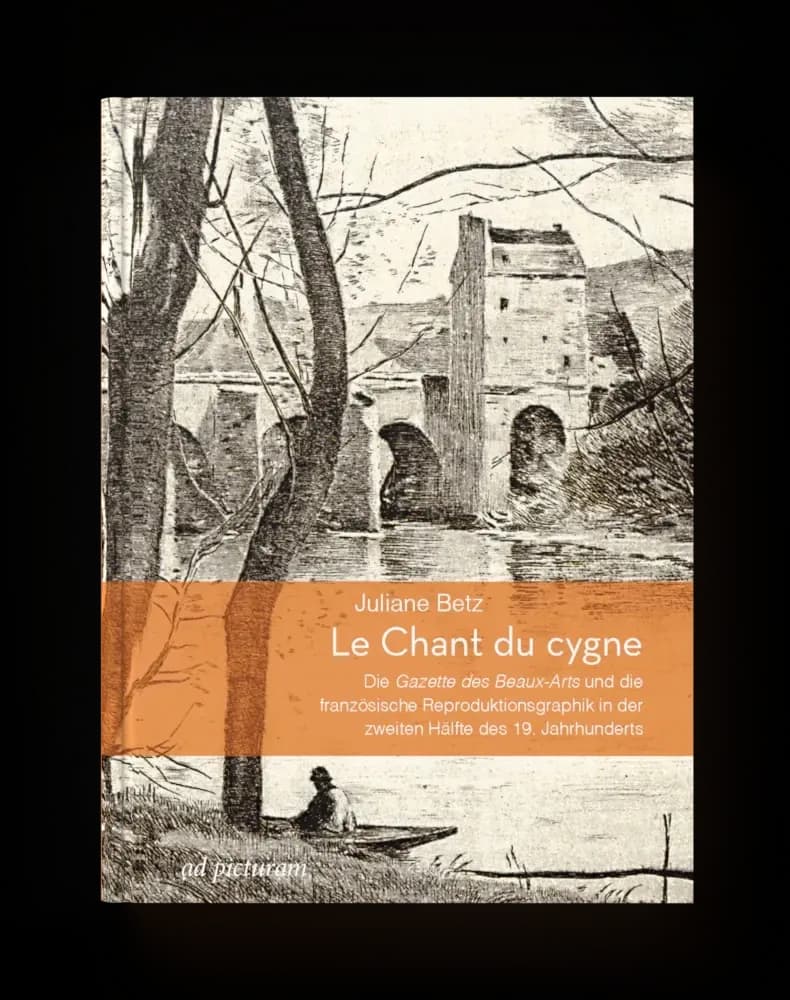
In his article about the Salon des Beaux-Arts of 1881, the critic Jules Buisson distinguished between the prints of the great engravers of the 17th and 18th centuries, which he called “Chant du Triomphe,” and those of the late 19th century, which he characterized as “Chant du Cygne.” The term “swan song” clearly indicates that the genre of reproduction graphics, which was perceived as quite artistic, was about to be replaced by photographic processes.
The present study of French reproduction graphics is based on the Gazette des Beaux-Arts, founded in 1859, one of the most important art magazines of the 19th century. Reproduction graphics were published there until 1927 and original graphics until 1933, which were also the subject of numerous articles. These are primarily about the expectations that were placed on print reproductions, about the assessment of individual sheets and graphic artists, and about the question of whether and why, given the possibilities of photographic reproduction, the “mere” reproduction of paintings or sculptures in the medium of printmaking should be viewed as an independent art.
64 reproduction prints were selected from the approximately 1,450 plates that the Gazett e regularly published up to 1900. The examination of these and other examples illustrates that there were two main tendencies in stylistic development during the fifty-year transition from manual to photographic art reproduction: First, the graphic artists oriented themselves towards reproduction engravings of the previous centuries and towards painter's etching, which revived from the 1840s. Later, some of them developed a method of reproduction that was clearly influenced by photography.
The publication contains a detailed catalog section.
Extra from the e-book edition:
The essays from the Gazette des Beaux-Arts, which are listed in the bibliography, are linked to the corresponding digital copies of the Heidelberg University Library magazine.
About the author:
Juliane Betz studied art history, Italian studies, educational sciences and historical anthropology in Freiburg im Br. and in Reggio Calabria. He received his doctorate at the University of Heidelberg in 2013. She is currently a research assistant at the Staatliche Kunsthalle Karlsruhe. Her research interests include printmaking, late 19th century French art, and repetition in art.